Reformer pilates: what it is and how to get started
Reformer pilates is training on a sliding carriage with adjustable spring resistance. The springs both challenge and support each movement, so the same exercises work for complete beginners, people getting back into shape and advanced clients. The easiest way to start is a calm class in a small group, where the instructor sets the machine up for you.
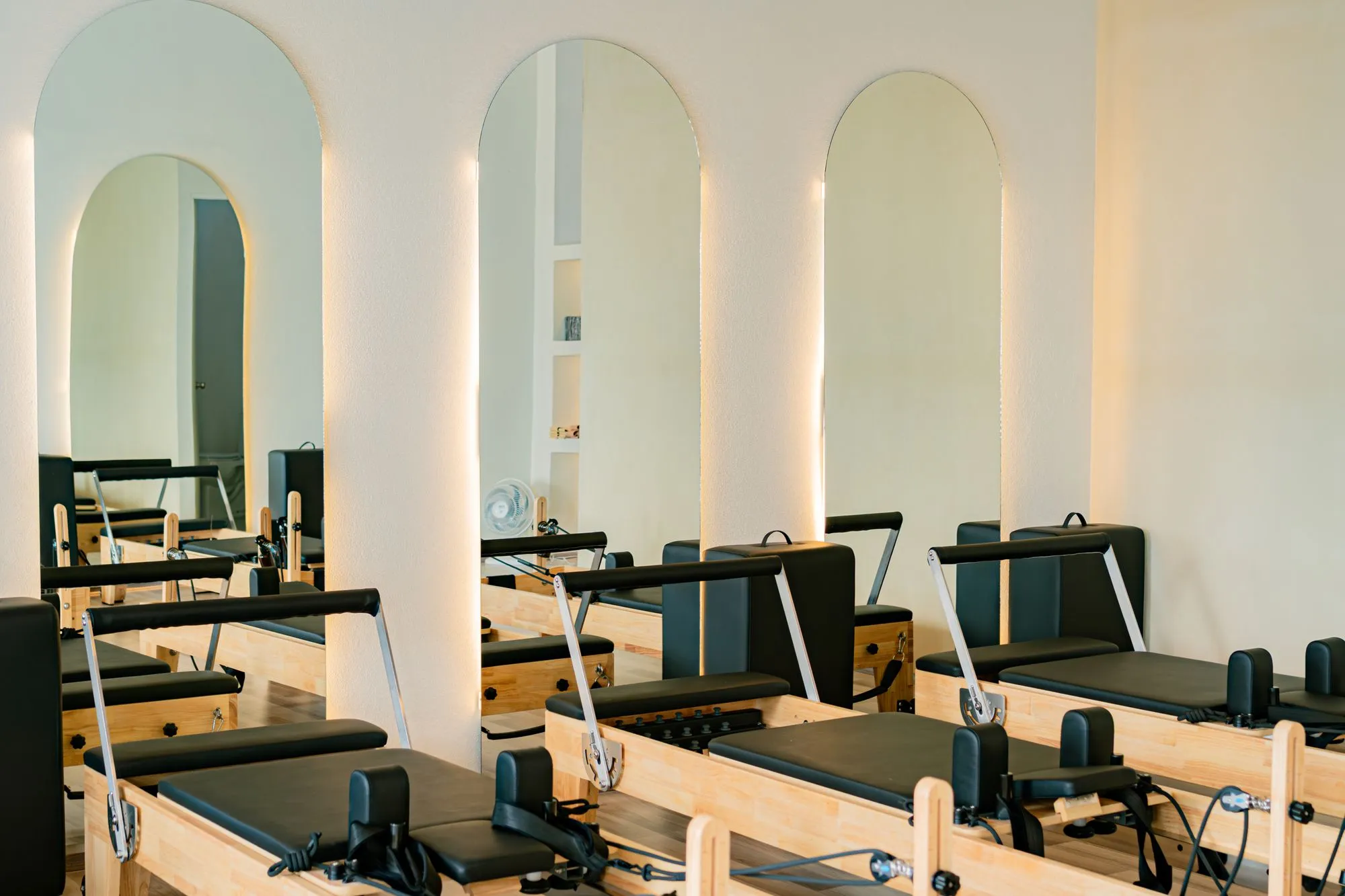
What is a reformer?
A reformer is a frame with a carriage that glides along rails. Springs of different strengths set the resistance, and you work lying down, sitting, kneeling and standing — with your feet on the footbar, in the straps or on the carriage itself.
The machine was designed by Joseph Pilates in the first half of the 20th century. Today it is the core piece of equipment in any pilates studio, alongside the tower (Cadillac), the mat and add-ons such as the jumpboard.
How it differs from mat pilates
On the mat you work with your own body weight, so many exercises are hard from the start — you have to stabilise your trunk with no help at all. On the reformer a spring can support you through the hardest part of a movement, or add resistance where the movement is easy.
That means the same movement pattern can be done gently or made very demanding. Mat and reformer complement each other well: the mat teaches control without support, while the reformer lets you do more, with greater precision.
What the springs next to each format mean
We show each format’s level as a number of springs: one means a class for everyone, including your very first; two means you already know the basics; three is for people who train on the equipment regularly. It is a difficulty scale for the class, not the number of springs on the reformer.
Who reformer pilates is for
For anyone who wants to strengthen their deep core muscles and improve mobility and body awareness without jumping or heavy loads. It works well as your main training or alongside running, the gym or long days at a desk.
- Starting from scratch or coming back after a break — choose Reformer Flow or Mat Core.
- Looking for harder strength work — move on to Reformer Sculpt after a few classes.
- Like a good sweat but want to spare your joints — Jumpboard Cardio.
- Pregnant (from the 2nd trimester, with your doctor’s consent) — Prenatal Reformer.
What your first visit looks like
Arrive 10 minutes early, in comfortable, close-fitting clothes and grip socks (you can buy them at the studio). Your instructor will ask about injuries and pregnancy, show you how to set the footbar, headrest and springs, and correct your position as you go.
Groups are small — up to 12 people on the reformers and up to 6 on the tower — so nobody is left guessing. Your first Reformer Flow or Mat Core class with us is free, once per person.
Six formats in one table
The number of springs shows the level: one is a class to start with, three is for people with experience.
| Format | Level | Length | Equipment | Who it suits |
|---|---|---|---|---|
| Reformer Flow | 50 min | Reformer | For your first class and regular training | |
| Reformer Sculpt | 50 min | Reformer | After a few Flow classes | |
| Jumpboard Cardio | 45 min | Reformer with jumpboard | When you want to sweat without running | |
| Tower Control | 55 min | Tower (Cadillac) | For experienced students | |
| Mat Core | 45 min | Mat | To start, and alongside the reformer | |
| Prenatal Reformer | 50 min | Reformer | In pregnancy and after birth |
Your path from the first class
- First classReformer Flow or Mat Core — get to know the equipment, the breathing and how to set your pelvis. Your first class is free.
- A regular rhythm2–3 Flow classes a week for a few weeks, until the movements feel natural and the springs are no longer a mystery.
- More intensityReformer Sculpt for strength or Jumpboard Cardio for fitness — without giving up on precision.
- The towerTower Control in a group of up to 6, once you know the basics well and want to work on the classical repertoire.
Frequently asked questions
Is reformer pilates suitable for beginners?
Yes. The springs can be set to support the movement, and in a small group the instructor sets up the equipment and corrects everyone individually. To start, we recommend Reformer Flow or Mat Core.
How many times a week should I train?
Twice a week is a good rhythm to begin with: enough to remember the exercises, with time left to recover. Many people later move up to 3 classes a week.
Is reformer pilates good for weight loss?
The reformer builds strength, control and mobility. Changes to your figure depend on many things, including diet and sleep, so we don’t promise specific results. If you want a harder workout, choose Jumpboard Cardio or Reformer Sculpt.
Can I train with back pain?
Often yes, but check with a doctor or physiotherapist first and tell your instructor before the class. With acute pain, a recent injury or after surgery, we postpone training until a specialist gives the go-ahead.
What should I bring to class?
Comfortable, close-fitting clothes, grip socks and water. Towels and mats are provided, and you can buy grip socks at reception.
Can I start straight away on the tower?
Tower Control is for people with experience on the equipment. If you have trained on a reformer at another studio, drop us a message and we’ll find the right level. Otherwise, start with Reformer Flow.
These descriptions are for information only and are not a substitute for advice from a doctor or physiotherapist. If you have an injury, a chronic condition or are pregnant, check with a specialist first and tell your instructor before the class.